We the People High School Textbook by Center for Civic Education
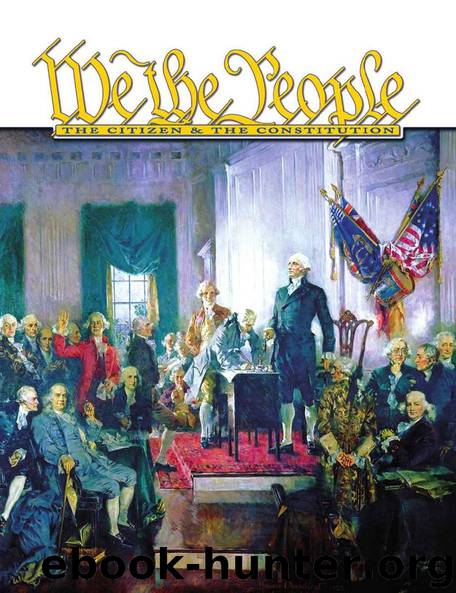
Author:Center for Civic Education [Education, Center for Civic]
Language: eng
Format: epub
Tags: epub, ebook
ISBN: 9780898183160
Publisher: Center for Civic Education
Published: 2012-07-18T16:00:00+00:00
Terms and Concepts to Understand
initiative
local governments
police powers
recall
referendum
reserved powers
What is the constitutional status of state governments?
As explained in Lesson 7, states were the only units of government in the United States after the Revolution. They had complete governing authority over the people within their boundaries. Under the Articles of Confederation states retained their “sovereignty, freedom, and independence” and all powers not “expressly delegated” to the United States.
The Constitution created a new national government, but it left, or “reserved,” many governmental powers to the states. James Madison argued in Federalist 45 that the powers of the states would “extend to all the objects which, in the ordinary course of affairs, concern the lives, liberties, and properties of the people, and the internal order, improvement, and prosperity of the State.”
States play an important role in the structure and operation of the national government. Article VII, for example, required the votes of “nine States” to ratify “this Constitution between the States.” Article I provides that the House of Representatives will be elected by voters who have the same qualifications as are required to vote for the “most numerous Branch of the State Legislature,” usually called a “house” or “assembly.” States are represented equally in the U.S. Senate. States also have a role in the Electoral College.
The Constitution suggests, but does not plainly identify, many governing powers left to the states. Article I, Section 10, lists powers that the states do not have. For example, no state can enter into treaties, alliances, or confederations, grant titles of nobility, or pass laws that impair the obligation of contracts. The list of what states cannot do implies that the states can do what is not prohibited. Article I describes the powers of Congress as those “herein granted,” again suggesting that governing powers not granted to Congress remain with the states. Moreover, the Tenth Amendment, added to the Constitution in 1791, states, “The powers not delegated to the United States by the Constitution, nor prohibited by it to the States, are reserved to the States respectively, or to the people.”
The reserved powers referred to in the Tenth Amendment often are called police powers, a term that refers to the inherent power of a government to enact legislation protecting the health, safety, welfare, and morals of those within its jurisdiction. Examples of police powers are laws creating and operating public schools, making and executing criminal and civil laws, and making and enforcing land use regulations, or “zoning.”
Although the states retain considerable governing powers, the Constitution, the laws made under it, and treaties made under the authority of the United States are the “supreme Law of the Land.” Since the beginning there has been tension between the Constitution’s supremacy clause and the powers of the states. Some constitutional scholars believe that ambiguities about which level of government has the power over matters of domestic politics are part of the genius of the American constitutional system. These ambiguities mean that both levels of government always must strive to win the confidence and support of the American people.
Download
This site does not store any files on its server. We only index and link to content provided by other sites. Please contact the content providers to delete copyright contents if any and email us, we'll remove relevant links or contents immediately.
The Art of Coaching Workbook by Elena Aguilar(51134)
Trainspotting by Irvine Welsh(21606)
Twilight of the Idols With the Antichrist and Ecce Homo by Friedrich Nietzsche(18599)
Fangirl by Rainbow Rowell(9208)
Periodization Training for Sports by Tudor Bompa(8236)
Change Your Questions, Change Your Life by Marilee Adams(7715)
This Is How You Lose Her by Junot Diaz(6854)
Asking the Right Questions: A Guide to Critical Thinking by M. Neil Browne & Stuart M. Keeley(5734)
Grit by Angela Duckworth(5574)
Red Sparrow by Jason Matthews(5446)
Paper Towns by Green John(5157)
Room 212 by Kate Stewart(5087)
Ken Follett - World without end by Ken Follett(4701)
Housekeeping by Marilynne Robinson(4418)
The Sports Rules Book by Human Kinetics(4363)
Double Down (Diary of a Wimpy Kid Book 11) by Jeff Kinney(4252)
Papillon (English) by Henri Charrière(4235)
The Motorcycle Diaries by Ernesto Che Guevara(4068)
Exercise Technique Manual for Resistance Training by National Strength & Conditioning Association(4048)
